
Marriage Law and Practical Guides
Nikah Certificates and Union Council Records in Pakistan
Understand Nikah certificates, Union Council marriage records, certified copies, corrections and overseas document use in Pakistan.
Read the Guide →Court Marriage: A Choice for a Recognized Bond
Understand court marriage consent, Mahr, registration, proof of marriage and the limits of local and overseas recognition in Pakistan.
Read the Guide →The Ins and Outs of Court Marriage in Pakistan
Explore court marriage eligibility, consent, previous marriages, registrar roles, documents, fees and warning signs before making arrangements.
Read the Guide →Court Marriage in Pakistan: Complete Process Guide
Follow the court marriage process from initial document review to Nikah, registration, certificate checks and final document handover.
Read the Guide →Court Marriage in Pakistan: Detailed Nikah Nama Guide
A detailed court marriage guide to Nikah Nama entries, Mahr, conditions, witness details, translations and checking the registered record.
Read the Guide →Clearing the Path to Court Marriage in Pakistan
Resolve court marriage document gaps, spelling errors, missing records, previous-marriage evidence and registration questions before proceeding.
Read the Guide →Planning Your Court Marriage in Pakistan
Plan court marriage documents, appointments, witnesses, Mahr, registration, costs and overseas document use with a practical preparation checklist.
Read the Guide →Court Marriage in Pakistan: Registration to Reception
Coordinate court marriage, registration, certificate collection and reception planning without confusing the ceremony with the civil record.
Read the Guide →Court Marriage in Pakistan: Complete Document-Use Guide
Plan court marriage records for local and overseas use: Nikah Nama, marriage certificate, translation, authentication and recipient requirements.
Read the Guide →Court Marriage Services in Pakistan’s Major Cities
Compare court marriage service routes in Karachi, Islamabad, Lahore, Rawalpindi, Faisalabad and Multan by documents, jurisdiction and follow-up.
Read the Guide →Court Marriage Benefits | Affordable Planning, Privacy and Clear Marriage Records
Compare the practical benefits and limits of court marriage: ceremony costs, private appointments, informed terms, registration and future document use.
Read the Guide →Court Marriage and Civil Marriage in Pakistan | Nikah, Registration and Legal Recognition
Separate common court marriage terminology from Nikah, statutory registration, affidavits and the role of courts in Pakistan.
Read the Guide →Divorce in Islam | Quranic Guidance, Talaq, Khula and Pakistani Legal Procedure
Read a careful guide to Quranic divorce principles, reconciliation, dignity, family responsibilities and the separate Pakistani legal procedure.
Read the Guide →Court Marriage by Free Choice | Consent, Family Concerns and Safe Legal Planning
Plan a marriage by free choice with informed consent, accurate records, careful handling of family concerns and realistic legal safeguards.
Read the Guide →NADRA Marriage Certificate | Why the Registered Civil Record Matters
Learn why a computerised marriage certificate matters, who issues it, and how to prepare an accurate record for local or overseas document use.
Read the Guide →Nikahnama Certificate | Marriage Evidence, Registered Copies and Corrections
Understand what a Nikahnama certificate proves, how to obtain a registered copy, and how it differs from a computerised marriage certificate.
Read the Guide →Online Nikah in Pakistan | Coordinating Karachi, Lahore, Islamabad and Rawalpindi Files
A practical Online Nikah guide to coordinating people, authority, local registration and document delivery across Karachi, Lahore, Islamabad and Rawalpindi.
Read the Guide →Online Nikah Requirements | Identity, Consent, Wakeel and Registration Checklist
Prepare for Online Nikah with a practical checklist for identity, consent, authorised representation, witnesses, marriage terms and registration.
Read the Guide →How to Do Court Marriage in Pakistan | A Practical Action Checklist
Follow a practical sequence for eligibility review, Nikah preparation, registration, record collection and overseas document planning in Pakistan.
Read the Guide →Information About Court Marriage in Pakistan | Making an Informed Decision
Understand court marriage terminology, consent, professional roles, marriage records, costs, privacy and the limits of general guidance in Pakistan.
Read the Guide →Marriage Certificate Fees in Karachi, Islamabad, Rawalpindi and Lahore
Compare certificate costs by task, authority and city. Separate official charges, professional fees, corrections, translation and overseas delivery.
Read the Guide →Marriage Law: Understand the Question First
Documents and Circumstances to Review
Marriage Law in Pakistan advice should identify whether the problem concerns eligibility, consent, an agreed term, registration, certification or a receiving institution's requirements. A question about marrying, proving a marriage and correcting a marriage record can involve different legal routes. That starting distinction is more useful than treating every difficulty as one generic court marriage case.
The Marriage Law guides below explain those subjects separately. A process guide shows the sequence, a detailed-record guide concentrates on Nikah Nama entries, and a recognition guide addresses evidence and later document use. Read the relevant page alongside your actual records rather than assuming that a headline resolves every individual fact.
Marriage Law and Free Consent
Marriage Law advice should establish that both parties understand and freely choose the proposed marriage. A signature or affidavit is not a substitute for examining the real circumstances where coercion or uncertainty is apparent. Each person should have the opportunity to ask questions and communicate their own instructions.
In a Marriage Law assessment, language, literacy and representative participation can affect how that understanding is established. Marriage Law advice should address the substance of consent instead of relying on a completed form alone. Where a genuine threat or safety issue exists, the appropriate protective or other legal route should be considered separately from the ceremony arrangements.
Continue Reading: Court Marriage: A Choice for a Recognized Bond
Adult Eligibility and Reliable Identity Evidence
Our service assists adults aged eighteen or above, both male and female, subject to applicable Marriage Law requirements. Reliable identity and age documents should be checked before an appointment. Sindh, Punjab and Islamabad have relevant child-marriage legislation, and the current applicable law must be respected in the actual jurisdiction.
An incorrect date, missing identity record or expired document calls for Marriage Law review and any necessary source-record procedure. Marriage Law should not be presented as a set of shortcuts around a restriction. Changing cities, using a false address or signing an unsupported age statement does not responsibly resolve an eligibility problem.
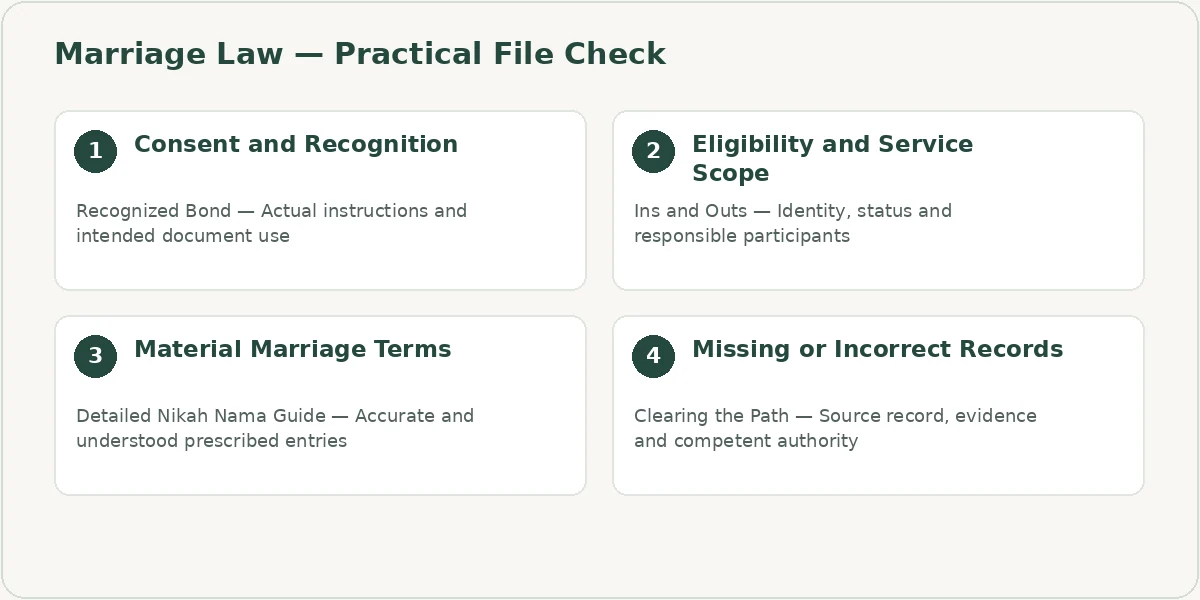
| Question | Guide to Read | Point to Verify |
|---|---|---|
| Consent and Recognition | Recognized Bond | Actual instructions and intended document use |
| Eligibility and Service Scope | Ins and Outs | Identity, status and responsible participants |
| Material Marriage Terms | Detailed Nikah Nama Guide | Accurate and understood prescribed entries |
| Missing or Incorrect Records | Clearing the Path | Source record, evidence and competent authority |
Marriage Law and Previous Marital Status
Under Marriage Law, a previous marriage can affect whether and how a person may proceed. Separation alone should not be confused with completion of the applicable legal divorce process. Divorce, dissolution or death records may need examination, including their chronology and the present legal position they establish.
An existing marriage raises separate Marriage Law issues, including applicable prior-permission requirements for a proposed additional marriage under the Muslim Family Laws framework. Marriage Law advice should identify the relevant obligation rather than conceal it through a standard declaration. A complex or disputed status question may require individual legal work before another ceremony is arranged.
Nikah Nama Terms and Their Legal Effect
Marriage Law questions about Mahr, payment arrangements, conditions and delegated authority deserve attention before signature. The prescribed Nikah Nama contains material questions about rights and responsibilities. Automatic deletion of important columns can create uncertainty about whether a conscious agreement was made.
A proposed term may need Marriage Law advice on drafting and legal effect, particularly where property or a substantial financial promise is involved. Marriage Law guides can identify the issues to discuss, but they should not promise that every privately drafted condition will be enforced exactly as expected. Accurate, informed instructions are essential.
Marriage Law and Statutory Registration
Section 5 of the Muslim Family Laws Ordinance supplies the core Muslim-marriage registration framework considered in these Marriage Law guides. The licensed Nikah Registrar and competent local authority have functions that should be distinguished from the person solemnizing the ceremony and from a private legal-service provider.
A computerized certificate, registered Nikah Nama and NADRA family record serve different purposes. Marriage Law questions about a missing entry or disputed particulars should begin with the correct source and authority. A private certificate or an edited scan cannot replace a genuine local record or settle a contested fact.
Corrections, Evidence and the Appropriate Forum
A Marriage Law enquiry may concern an administratively correctable clerical error or a material dispute requiring a competent legal forum. Determine which record is affected and what evidence supports the claimed correction. Preserve applications and replacement documents so that the document history remains understandable.
The Marriage Law guides on record checks and clearing documentation obstacles explain this distinction in practical terms. Marriage Law advice should support transparent accuracy. It should not recommend backdating, invented particulars or a translation that silently changes the source in order to satisfy a later application.
Marriage Law and Overseas Recognition
Pakistani Marriage Law documentation and foreign recognition are connected but separate questions. A receiving country or institution may require a particular document set, translation or authentication route. Proxy participation can attract specific recognition rules that should be checked before relying on the arrangement for overseas purposes.
An apostille or other authentication step does not itself guarantee immigration eligibility or visa approval. Marriage Law guidance should explain the local record and its limits, then identify which overseas institution must answer the foreign-use question. Another person's successful application is not a universal legal rule for every couple.
Marriage Law Resources and Individual Advice
Use the linked Marriage Law resources according to their subject: process sequence, planning, Nikah Nama entries, institutional document use or city-route comparison. The city comparison explains practical local-route differences. Relevant service pages provide the next contact step once the legal question is understood.
Court Marriage Live Service offers an initial ten-minute free telephone consultation. Detailed Marriage Law opinions, disputed-record work and representation are separately scoped according to the evidence and forum involved. Marriage Law information is most useful when it helps a person ask the right question, preserve the right record and identify the authority able to decide the actual issue.
For a Marriage Law consultation, prepare a short chronology rather than only a collection of images. Identify the parties, relevant dates, current records and the exact question requiring advice. If a document contains an apparent inconsistency, point it out and keep the original version available. A clear chronology helps distinguish an administrative error from a disputed event or a legal process that has not yet been completed.
When reading a Marriage Law guide, keep its subject and limits in view. An explanation of registration does not by itself answer a dispute about consent. A discussion of authentication does not decide foreign recognition. A description of Mahr does not determine the enforceability of every privately proposed property condition.
The linked pages are designed to identify the relevant questions and records so that further advice can be focused on the actual issue.
Where Marriage Law proceedings are pending, identify the forum and provide relevant orders or notices to the advisor. Do not rely on a general webpage to ignore a direction or deadline. The appropriate response depends on the evidence, applicable law and procedural position. An individual opinion can then address the specific task rather than applying a generic checklist to facts that require a different legal route.
Continue Reading: The Ins and Outs of Court Marriage in Pakistan · Discuss Your Case
Preparing Evidence for Advice on Marriage Law in Pakistan
A useful Marriage Law enquiry separates the facts from the conclusion a person hopes to reach. Write what happened, when it happened, which records exist and what question requires advice. A person may want a certificate urgently, but the underlying issue could concern an incomplete registration or disputed identity entry. Giving the advisor a clear chronology helps identify the correct legal or administrative route before another application is prepared.
Keep each document’s status clear when seeking Marriage Law advice. An unsigned draft, a signed copy, a registered copy and a computerized certificate are different records. A photograph of a document may be enough for an initial discussion but may not satisfy the authority deciding the application. Explain which original is available and which version has already been submitted elsewhere. Do not improve the evidence by privately altering the scan.
Where a Marriage Law question concerns disputed consent or a material term, preserve the communications and records relevant to that issue. A general webpage cannot decide a contested fact. The appropriate forum may need evidence, and the advisor needs to understand any proceedings already pending. Tell the team about notices, orders and deadlines so that an administrative checklist is not mistaken for a response to a judicial direction.
The distinction between procedure and substantive Marriage Law also matters for foreign documents. An authentication question concerns the relevant document procedure, while recognition and immigration eligibility may depend on the receiving jurisdiction’s substantive rules. Obtain the institution’s actual request and identify what it is asking to verify. Another stamp or translation cannot be assumed to answer every type of objection.
Use the linked Marriage Law resources to identify the relevant subject and prepare better instructions. The recognized-bond guide explains consent and evidence, the detailed-record guide concerns Nikah Nama entries, and the obstacle guide concerns missing or inconsistent records. The process and planning guides show how those questions fit into an ordinary assignment.
Together they help a person preserve useful records and seek advice from the right source, while leaving disputed legal conclusions to an individual review of the evidence and applicable law.
When several institutions are involved in a Marriage Law question, identify which issue belongs to each. The local record holder can explain an entry or its correction procedure; a receiving institution can explain its required document format; a legal advisor can assess the rights or dispute presented by the evidence. Do not assume that one institution’s administrative acceptance resolves every other legal issue.
Keep Marriage Law advice and instructions linked to the actual facts reviewed. If a new order, document or previous-marriage record appears, tell the advisor rather than continuing to rely on an earlier answer to a different question. This is particularly important where an appointment or overseas deadline creates pressure to proceed quickly.
A focused update allows the advice to address the changed file without inventing a conclusion or ignoring a material fact.
Marriage Law FAQs
What subjects does this Marriage Law directory cover?+
It links to guides on consent, adult eligibility, Nikah Nama terms, registration, document problems, planning and overseas use. Choose the page matching the actual question.
Does court marriage always mean a judge creates the marriage?+
No. For an ordinary Muslim couple, the usual process concerns Nikah, prescribed documentation and registration. Court proceedings address particular legal disputes or remedies.
What is the service age requirement?+
Our service assists adults aged eighteen or above, both male and female, with reliable age evidence and compliance with the law applicable to the jurisdiction.
Can an affidavit replace genuine consent?+
No. A statement may record a person's position, but it cannot manufacture voluntary consent or resolve coercion contrary to the actual facts.
Does separation establish that a previous marriage ended?+
Not by itself. The applicable divorce or dissolution process and its records need review before advice is given about a proposed further marriage.
Why read the Nikah Nama carefully?+
It records identities and material marriage terms, including Mahr and prescribed rights-related questions. Understand the entries before signature rather than treating them as routine blanks.
Is registration the same as overseas recognition?+
No. Local registration, document authentication and a foreign authority's recognition or immigration decision are separate questions with different requirements.
Can an official mistake be fixed privately?+
No. Identify the source record and competent authority and follow the appropriate correction process. A contested material fact may require separate legal advice.
Which guide should I read about overseas use?+
The complete document-use guide explains registered records, certificates, translation and authentication questions, with reminders to verify the receiving institution's requirements.
Can I obtain an individual legal opinion?+
Contact the team with a factual summary and available records. The initial ten-minute telephone consultation is free; further review or representation is separately scoped.
Official Legal and Registration References
These guides concern adult Muslim marriage and related documentation. Special circumstances require review under the applicable law and the competent authority's current procedure.
Edited for Court Marriage Live Service · Last Updated: