
Court Marriage and a Freely Chosen Relationship
Documents and Circumstances to Review
Court Marriage, in ordinary discussion, describes a marriage arranged with legal assistance for adults choosing their spouse. For a Muslim couple, the usual legal work concerns a valid Nikah, the prescribed marriage record and registration. It does not mean that every couple must exchange vows before a judge or receive a judicial order creating the marriage.
The distinction matters because a Court Marriage package should not be sold as blanket court approval of every circumstance. Eligibility, identity, marital status and the actual marriage arrangements need review. A couple should know what the lawyer will do, what the Nikah Khawan will do and what the competent registrar or local authority must still decide or record.
Genuine Consent and Independent Instructions
Each person considering Court Marriage must make their own decision freely and understand the proposal and terms. Family pressure, an agency's timetable or a partner's insistence should not replace personal consent. A private conversation may be necessary where one person appears uncertain, cannot speak openly or has not seen the Court Marriage documents prepared in their name.
An affidavit can record a statement but should never be treated as a device that manufactures consent or removes the need to examine the real facts. No one should sign blank forms or allow another person to fill material details later without review. Court Marriage assistance should make the decision clearer and more informed for both parties, not rush them past important questions.
Continue Reading: The Ins and Outs of Court Marriage in Pakistan
Court Marriage Eligibility and Identity Checks
Our services are for adults aged eighteen or above, both male and female. Verify age and identity for Court Marriage using reliable documents before arranging the Nikah. Where an identity document contains an apparent error, resolve the issue through an appropriate evidence-based process. An informal age statement should not be used to bypass a statutory restriction.
Current marital status also matters. A prior marriage, an unresolved divorce process, widowhood or an existing marriage can change the legal questions. In a proposed additional marriage, the applicable prior-permission requirements under the Muslim Family Laws framework need specific review. A claim that two consenting people can ignore every other legal requirement is an unsafe description of Court Marriage.
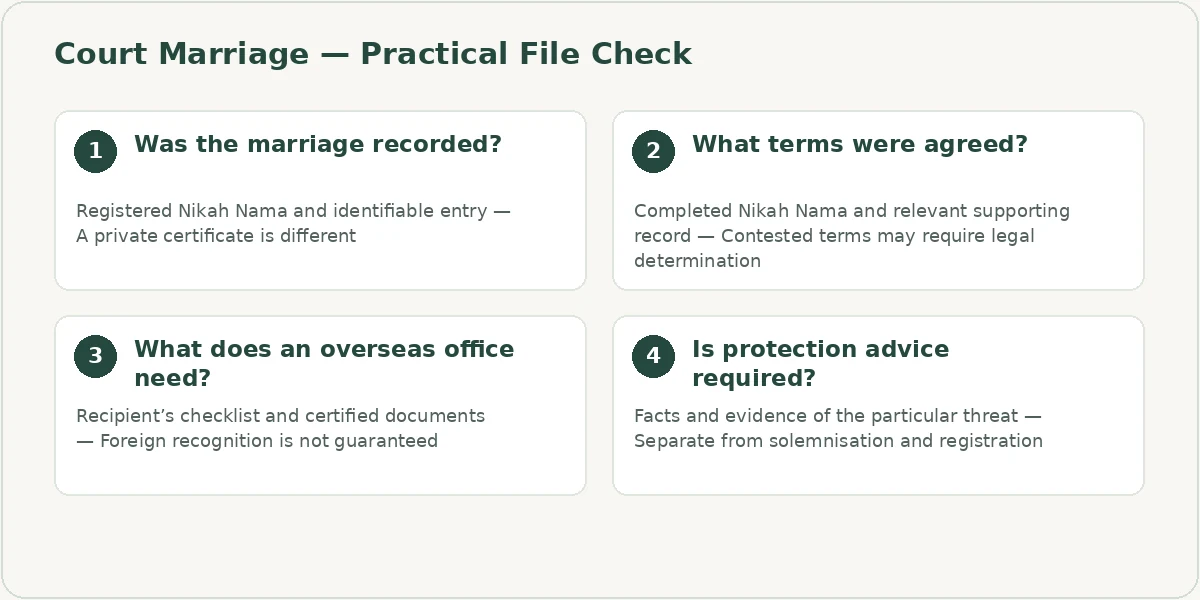
| Question | Useful Evidence | Important Limit |
|---|---|---|
| Was the marriage recorded? | Registered Nikah Nama and identifiable entry | A private certificate is different |
| What terms were agreed? | Completed Nikah Nama and relevant supporting record | Contested terms may require legal determination |
| What does an overseas office need? | Recipient’s checklist and certified documents | Foreign recognition is not guaranteed |
| Is protection advice required? | Facts and evidence of the particular threat | Separate from solemnisation and registration |
Understanding Mahr and Payment Arrangements
Mahr in a Court Marriage is an agreed marital obligation, not simply a decorative number inserted to complete a form. The parties should discuss the amount or property, the mode of payment and whether it is prompt, deferred or divided between the two. The Nikah Nama should accurately record the agreement and avoid a description that contradicts what the parties actually decided.
A Court Marriage promise involving property needs sufficient detail to identify the obligation. Unclear references to gold, a house or future payment can become difficult to interpret when a dispute arises. The parties should ask questions before signing and keep the relevant record. A thoughtful Court Marriage consultation gives these terms attention even when the ceremony itself is brief.
Read Material Nikah Nama Terms Carefully
The prescribed Nikah Nama used for Court Marriage contains more than names and signatures. Questions concerning agreed conditions, delegated divorce authority and existing marital status should be handled with care. Material columns should not be crossed out automatically on the assumption that the couple will never need them. Each person should understand any entry affecting their rights.
Some proposed Court Marriage conditions may require careful drafting or legal advice on their effect and enforceability. The document should not promise a remedy that the law does not permit. If a person cannot comfortably read the language of the form, arrange an explanation they understand. Court Marriage creates lasting obligations, so a few minutes spent reading can prevent years of uncertainty.
Court Marriage Registration and Evidence
Court Marriage registration provides a formal record within the applicable statutory process. The signed Nikah Nama, the registered entry and a computerized Marriage Registration Certificate are connected records with different functions. Keep them together and compare the key particulars. A private souvenir certificate should not be confused with the official civil record.
If a Court Marriage record later needs to be produced in a court or before a public authority, its source and accuracy matter. An apparently small spelling discrepancy can require explanation. Missing signatures or uncertain registrar details may need more substantial review. Court Marriage documentation should therefore be checked at collection rather than left untouched until an urgent visa, inheritance or family dispute arises.
Court Marriage Recognition Within Pakistan
An accurate marriage record can assist with family documentation and with proving the recorded marital relationship when a legitimate need arises. It may be relevant to a spouse's identity record, children's records, employment benefits, succession or family litigation. The particular institution decides which evidence its process requires; a generic website checklist cannot bind every office.
Court Marriage registration is also different from adjudicating a contested question. If a person denies the marriage, alleges coercion or disputes a material term, a competent forum may need to examine evidence. No private provider can guarantee how a court will decide. The practical aim of careful Court Marriage preparation is a lawful, coherent record, rather than a promise that no future issue could ever occur.
Court Marriage and Recognition Outside Pakistan
Recognition of a Court Marriage abroad depends on the receiving country’s rules and the purpose for which its documents are submitted. A marriage acceptable for one administrative purpose may still need additional evidence for immigration or a particular civil register. Remote or proxy arrangements can attract specific destination-country rules and should be reviewed before the ceremony where foreign use is planned.
Ask the recipient for its current written requirements for Court Marriage records. Translation, Ministry of Foreign Affairs authentication, an apostille where applicable or another legalisation route may be necessary. These processes do not guarantee a visa. A Court Marriage service should distinguish lawful Pakistani documentation from the separate decision of a foreign institution and avoid promising universal recognition.
Confidentiality and Personal Safety
Private handling of a Court Marriage file means sharing sensitive identity and family documents only for authorized purposes. It does not mean that a statutory register becomes invisible or that a provider can guarantee absolute secrecy. Discuss communications, collection and representation arrangements sensibly, particularly where a family disagreement creates practical concerns.
If there is a real threat, coercion or a complaint affecting a party's safety, seek case-specific legal advice beyond routine Court Marriage arrangements. Protection or other court proceedings are separate from the Nikah and registration process. A Court Marriage package cannot provide blanket immunity from every allegation or substitute for an appropriate response to a genuine legal risk.
Court Marriage: Making an Informed Commitment
Before confirming Court Marriage arrangements, both parties should be able to ask about their documents, agreed terms, ceremony, registration and record collection. Understand who is being retained and what the quoted professional service includes. Ask which charges relate to official processing and which relate to advice, travel, translation or authentication.
Court Marriage Live Service can organize a Court Marriage review and identify the next lawful step for an adult couple. The initial ten-minute telephone consultation is free. Bring any concern about consent, marital status or document accuracy into the first conversation. A recognized bond is better supported by clear understanding and proper records than by speed alone.
Continue Reading: Court Marriage in Pakistan: Detailed Nikah Nama Guide · Discuss Your Case
Understanding a Commitment Before Recording It
A couple choosing Court Marriage by free choice may agree to marry while still needing advice about the terms being recorded. For example, both may use the word deferred Mahr but understand the payment differently. One may believe a property promise is a present transfer while the other understands it as a future obligation. These are questions to clarify before signing.
A provider should record the actual agreement and identify where legal drafting or separate evidence is needed, rather than choose a standard entry for convenience.
Both parties to a Court Marriage should receive an explanation they understand. If an interpreter is needed, clarify who will interpret and how the instructions will be confirmed. A friend helping with logistics should not silently become the decision-maker for a spouse. Where a representative is authorized, the scope of that authority should correspond to the acts proposed.
The purpose of Court Marriage representation is informed participation, not simply collecting enough signatures to complete a file.
Distinguish the agreed Court Marriage terms from a later administrative request. An employer’s form may ask for a spouse’s name without requiring the full terms of the Nikah Nama. A family dispute may require the complete record and supporting evidence. Share the appropriate document for the legitimate purpose, while protecting information that the recipient does not need. A secure copy of the fuller registered record should remain available to the spouses.
A spelling discrepancy illustrates why Court Marriage records deserve early checking. Suppose a passport and Nikah Nama use different English spellings for the same spouse. That does not automatically decide whether the marriage exists, but it can create an avoidable question when an institution checks identity. Identify the source of the variation and seek the appropriate clarification or correction before obtaining several translations.
Do not change the marriage facts in a new application merely to make two documents appear identical.
A sound Court Marriage service relationship also makes completion understandable. Ask what will be delivered, which official step remains pending and who will retain any original temporarily. Record changes to Court Marriage instructions if the couple moves cities or decides to use the documents abroad. The legal bond and its evidence should not depend on a provider’s informal promise that paperwork will arrive eventually.
Clear instructions, accurate terms and a traceable official record give the couple a practical foundation for later family and administrative needs.
Both spouses should retain complete, legible Court Marriage records and understand where the registered entry is held.
Court Marriage FAQs
Does Court Marriage always require a judge?+
No. For an ordinary Muslim marriage, the usual process concerns lawful Nikah, documentation and registration. Judicial proceedings are separate where a particular legal issue requires them.
Why is free consent essential?+
Each person must choose and understand the marriage voluntarily. Forms or affidavits do not replace genuine consent or cure coercion in the underlying facts.
What age does your service require?+
We assist adults aged eighteen or above, both male and female, with reliable identity and age documents and a review of the applicable local requirements.
Is Mahr optional paperwork?+
Mahr is an important agreed marital obligation. Its amount or property, payment terms and accurate recording deserve discussion before the Nikah Nama is signed.
Should blank Nikah Nama columns be ignored?+
No. Material columns should be explained and completed appropriately. Signing blank forms or automatically crossing out rights-related entries can create serious uncertainty.
Does registration remove every possible dispute?+
No. Registration supplies an official record. A contested marriage or disputed term may still require evidence and a competent forum's determination.
Is foreign recognition automatic?+
No. The receiving country's rules and the purpose of submission matter. Translation, authentication and additional evidence may be required.
Can a marriage service guarantee a spouse visa?+
No. Immigration decisions belong to the relevant foreign authority. Proper marriage documentation does not by itself guarantee visa eligibility or approval.
Does confidential handling mean the record is secret?+
Sensitive documents should be handled privately, but statutory records follow their own access rules. Absolute secrecy cannot responsibly be guaranteed.
What should we discuss first?+
Start with ages, identities, present marital status, consent, agreed terms and intended document use. Explain any safety or record concern before booking arrangements.
Official Legal and Registration References
These guides concern adult Muslim marriage and related documentation. Special circumstances require review under the applicable law and the competent authority's current procedure.
Edited for Court Marriage Live Service · Last Updated: