Nikah Services In Pakistan
Nikah services for couples who need clear assistance with solemnisation arrangements, documentation and the relevant registration steps.
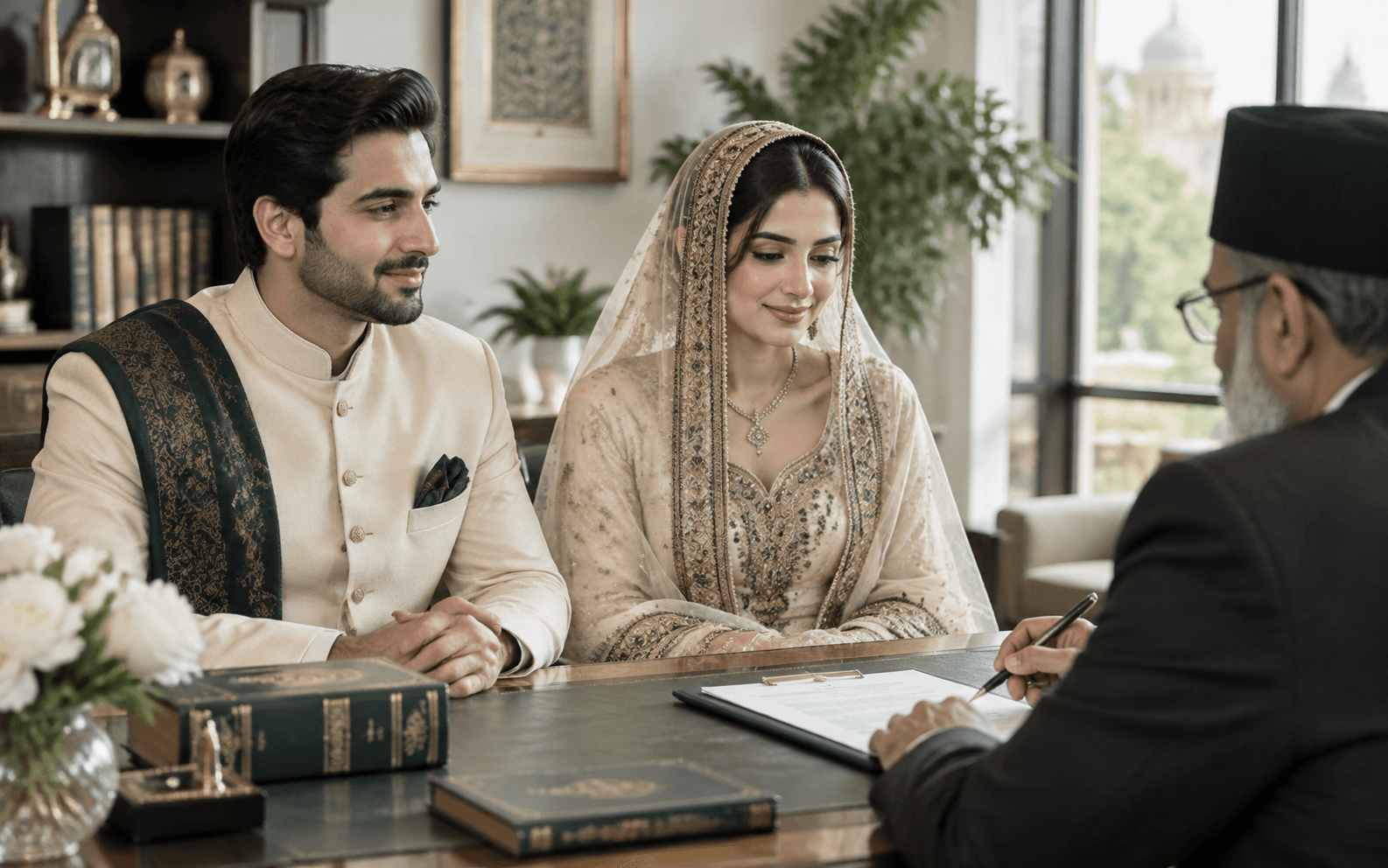
Nikah Services In Pakistan: What You Should Know Before Proceeding.
This page is intentionally detailed so a client can understand the major legal, documentation and registration issues before booking a service. Individual facts can change the answer, so general information should not be treated as a substitute for review of a specific file.
Nikah Services In Pakistan: What The Service Actually Covers
Nikah Services in Pakistan should be understood as a structured legal and documentation service, not as a slogan. The central purpose is lawful Nikah solemnisation, correct Nikah Nama preparation and marriage registration support. A useful service begins by identifying the parties, confirming free consent and present marital status, understanding where each person is located and deciding which legal and religious requirements apply. The process should then connect the Nikah to a reliable documentary trail and the competent registration authority. A provider should explain each stage instead of giving the impression that a single online form, affidavit or video meeting automatically creates a complete registered marriage.
The people most likely to need nikah services in pakistan include adult couples seeking a clear and properly documented Nikah, including local, inter-city and overseas cases. Their cases can look similar on the surface but differ materially once nationality, previous marriage, age, place of residence, planned ceremony, proxy authority and intended use of the documents are examined. For that reason, CourtMarriage.live should start with a short factual review and then provide a tailored checklist. The objective is to make the process understandable while preserving legal accuracy and a clear separation between solemnisation, Nikah Nama preparation, registration and any later certificate, translation or attestation step.
Nikah Services In Pakistan and The Muslim Family Laws Registration Framework
For Muslim marriages in Pakistan, section 5 of the Muslim Family Laws Ordinance, 1961 provides that every marriage solemnised under Muslim law shall be registered in accordance with that framework. Union Councils or the relevant local structure license Nikah Registrars, and a marriage solemnised by another person is to be reported for registration. This legal background remains important when discussing nikah services in pakistan because private arrangements cannot be allowed to replace the statutory marriage record. The method of communication may change, but the need for a reliable registration route does not disappear.
A client should therefore ask practical questions: who will solemnise the Nikah, who is the relevant Nikah Registrar, how will the prescribed form be completed, where will the record be registered and what certificate or certified copy will be available afterwards? A Nikah may be solemnised by a person other than the licensed Nikah Registrar, but the marriage must still be reported and registered through the lawful process under the Muslim Family Laws framework. This is especially important where the parties are in different countries or intend to use the marriage documents for immigration, passport, inheritance or family-registration purposes. The official trail should be planned before the ceremony rather than reconstructed only after an embassy, court or immigration authority asks for proof.
Nikah Services In Pakistan: Identity, Age and Free Consent
Identity and free consent are foundational in nikah services in pakistan. A remote or document-heavy process creates more opportunities for impersonation, misunderstanding or reliance on an outdated scan. Original identity information should be verified as far as reasonably possible and the names, dates of birth, parentage and identity numbers used in the Nikah record should be consistent with the documents that will later support registration. If the parties speak different languages, the contents of the Nikah and any authority document should be explained in a language each person understands.
Age must be checked under the law applicable to the place and circumstances of the marriage. Sindh, Punjab and Islamabad now have legislation setting eighteen as the relevant minimum age for both sexes in their respective jurisdictions. A service should not rely on an old gender-based internet rule or accept an approximate age. Where a party's date of birth differs between records, the discrepancy should be resolved before the Nikah is scheduled. A provider involved in nikah services in pakistan should never facilitate a prohibited child marriage or create paperwork intended to conceal a party's true age.
Nikah Services In Pakistan Documents and Case-specific Checklist
CNIC, NICOP or passport information, photographs where required, witness identification, prior-marriage documents and any authority documents for a proxy arrangement should be checked before the Nikah Nama is completed. The exact list depends on the service. A straightforward adult Pakistani couple may require a relatively simple file, while a foreign national, divorced person, widow or overseas party may need several additional records. The right approach is to identify the legal purpose of each document. A passport proves identity and nationality; a divorce record addresses previous marital status; a power of attorney shows the scope of representation; a translation allows an authority to understand a foreign-language document.
For nikah services in pakistan, document quality matters as much as document quantity. Blurred scans, cropped passports, unsigned authority letters and inconsistent spellings can delay registration or create doubt. Couples should avoid sending sensitive identity documents to multiple unverified persons merely to obtain competing quotations. A professional intake process should explain which documents are necessary at the preliminary stage and which originals or certified records will be required later. Where a foreign document is relied upon, the need for certification, translation, attestation or legalisation should be checked instead of assumed.
Nikah Services In Pakistan and The Role of Witnesses
Witness arrangements are an important part of Nikah planning and should be handled according to the applicable religious requirements and the facts of the case. In nikah services in pakistan, the fact that parties communicate remotely does not justify inventing witness details or treating people who did not observe the relevant acts as formal witnesses. The service should identify who will act as witnesses, confirm their identity information and ensure they understand the role they are performing. Their particulars should be recorded accurately where the prescribed document requires them.
Remote participation also raises practical questions about how the witnesses, parties, Nikah Khawan and any authorised representative communicate and how the sequence is documented. Technology can support a lawful arrangement, but it should not be used to create a false appearance of presence or consent. If a particular school of law, authority or factual situation requires a different arrangement, the adviser should identify that issue before the ceremony. Clear witness planning protects the validity and evidentiary value of the marriage record and reduces later arguments about who was present and what was agreed.
Nikah Services In Pakistan: Mahr and Nikah Nama Clauses
Mahr should be agreed clearly before the Nikah Nama is finalised. The amount or property, whether it is prompt or deferred, and any agreed payment arrangement should be recorded accurately. The couple should also understand the other entries in the prescribed Nikah Nama rather than treating it as a ceremonial form that can be filled in by someone else after the event. Nikah Services in Pakistan can involve extra communication steps, so it is particularly important to confirm the contents with both parties before signatures or authorised acts occur.
Where lawful special conditions, delegated rights or other permitted entries are relevant, they should be discussed in advance. Blank columns should not be converted into a default policy merely because that is convenient for a service provider. A party who cannot read the form should have the material terms explained. If the couple later relies on the record in maintenance, Mahr, dissolution, immigration or inheritance proceedings, the accuracy of the original Nikah Nama becomes important. Good nikah services in pakistan practice therefore treats the form as a substantive legal record rather than an administrative afterthought.
Nikah Services In Pakistan Where One Party Has A Previous Marriage
Previous marital status needs careful review in nikah services in pakistan. A divorced person should be able to show the relevant documentary basis for the present status, whether that arises from talaq, khula, judicial dissolution or another lawful process. A widow or widower may need an official death record. If the earlier marriage or divorce occurred abroad, a foreign decree or certificate may need translation, authentication or legal analysis before it can safely be relied upon for a Pakistani marriage record.
A service should not assume that a person's description of the earlier relationship is enough for official purposes. Likewise, the existence of a divorce decree does not always answer every question about notices, effectiveness or record updates. The file should be assessed according to how the previous marriage ended and what the competent authority requires. This is particularly important in nikah services in pakistan because remote communication can tempt parties to send only selected screenshots or informal statements. The objective is to establish a reliable present status before a new Nikah is recorded.
Nikah Services In Pakistan for Overseas Pakistanis
Overseas Pakistanis commonly need nikah services in pakistan because travel dates, employment, immigration status or family circumstances make simultaneous physical presence difficult. The process should begin with passport, CNIC or NICOP review and a clear explanation of where each party will be located at the relevant time. If an authorised representative will act, the authority document should identify the person and the acts permitted with enough precision to avoid doubt. Local notarisation, consular attestation or another authentication step may be needed depending on where the document is executed and how it will be used.
After the Nikah, an overseas couple should think ahead to the destination country. A Pakistani registered marriage document may need an English translation, MOFA attestation, embassy or consular legalisation, or another verification procedure. These are separate from the validity and registration of the Nikah itself. CourtMarriage.live should therefore ask where the couple intends to use the document and explain that Pakistani processing cannot guarantee automatic acceptance by every foreign immigration, civil-status or court authority. Planning the post-marriage document path early can prevent avoidable delay.
Nikah Services In Pakistan for Foreign Nationals
Foreign-national cases require an individual checklist. Nationality, religion, visa or entry position, residence, current marital status and the law of the destination country can all affect the documents requested in practice. Some cases may involve a consular letter, affidavit, proof of single status, divorce document, translation or additional identification; others may not. A responsible nikah services in pakistan service should not advertise a universal embassy NOC as if one form applies to every passport holder.
It is also important to separate Pakistani marriage requirements from later recognition abroad. A local authority may accept a marriage for registration while a foreign state asks for additional evidence before recording it in its own civil system. Conversely, a foreign document that appears sufficient to the couple may need authentication before a Pakistani authority can rely on it. The safest process is to review the actual passport, marital-status evidence and intended destination use, then prepare the Nikah and registration file around those facts.
Nikah Services In Pakistan: Registration and Computerised Marriage Record
A Nikah may be solemnised by a person other than the licensed Nikah Registrar, but the marriage must still be reported and registered through the lawful process under the Muslim Family Laws framework. Couples should understand the difference between the signed Nikah Nama, the registered Nikah record and any computerised Marriage Registration Certificate produced through the competent local authority. The public often calls the computerised document a NADRA marriage certificate, but NADRA is not the body that solemnises the marriage and the local registration step should not be described as a direct NADRA ceremony or approval.
For nikah services in pakistan, the registration trail is especially important because the parties may not be physically present later to correct an error. Names, identity numbers, nationality and marital-status details should be checked before the record is submitted. If the document will be used abroad, the couple should ask for the appropriate certified or translated version rather than editing scans themselves. A clean and traceable record is more useful for visa, family, inheritance and identity purposes than a collection of informal affidavits or screenshots that cannot be matched to the official marriage register.
Nikah Services In Pakistan: What Technology Can and Cannot Do
The Nikah ceremony should not be reduced to a form-signing exercise. Free consent, the applicable religious requirements, witnesses, Mahr and accurate information in the marriage record all require attention. Technology is useful for identity interviews, document exchange, translation, scheduling and communication among parties in different places. It can also help create a contemporaneous record that instructions were discussed. But technology should support the legal process rather than be advertised as the legal process itself. A platform, Zoom call or WhatsApp conversation has no power to waive age law, correct an invalid authority document or replace statutory registration.
Clients should also consider privacy. Passports, CNIC images, signatures and family documents should not be uploaded indiscriminately to public links or shared with multiple unknown intermediaries. A professional nikah services in pakistan workflow should use limited access, explain why a document is requested and avoid retaining material longer than reasonably required. Remote work can be efficient, but it also increases the importance of confirming who is on the other side of the communication and whether the person giving instructions is genuinely the contracting party.
Nikah Services In Pakistan Fees and Service Scope
A quotation for nikah services in pakistan should say what the client is paying for. The scope may include legal consultation, document review, drafting an authority document, arranging a Nikah Khawan, preparing the Nikah Nama, registrar coordination, registration follow-up, certificate assistance, translation, courier or attestation support. Government fees and third-party charges should be identified separately where possible. A headline fee without a scope can create disputes when the client later discovers that a certificate, attestation or foreign-document review was not included.
The amount can also vary with complexity. A straightforward local Nikah does not involve the same work as a foreign-national case with prior divorce records and overseas powers of attorney. CourtMarriage.live should therefore obtain enough facts to price the work responsibly. The client should be told which steps depend on a government office or another authority and cannot be guaranteed by the private service. Clear pricing and realistic expectations are part of professional service, not an obstacle to conversion.
Nikah Services In Pakistan Timeline and Appointment Planning
Clients often ask how quickly nikah services in pakistan can be completed. The answer depends on what is meant by completed. A consultation and document review may be done quickly; a Nikah may be arranged promptly when the parties, witnesses and documents are ready; registration and certificate issuance then depend on the competent authority. If a foreign document needs authentication or a previous marriage record is incomplete, additional time should be expected. A single promise covering every stage is therefore misleading.
A better planning method is to work backwards from any genuine deadline. If the couple has a flight, visa interview, family event or immigration filing date, that date should be disclosed at the first consultation. The adviser can then identify which private steps can reasonably be scheduled and which official stages remain outside direct control. In nikah services in pakistan, time-zone differences and courier or consular requirements may also matter. Early disclosure of the real deadline allows the service to prioritise the correct documents instead of rushing into an incomplete Nikah record.
Common Mistakes In Nikah Services In Pakistan
Common mistakes include relying on an online template without checking current law, using an expired or unreadable identity document, assuming a video call alone creates a registered marriage, treating every Nikah Khawan as the relevant licensed registrar, failing to document a previous divorce, leaving material Nikah Nama entries unexplained, and promising universal recognition abroad. Another frequent problem is the use of the phrase NADRA marriage certificate without explaining which local authority actually handles the marriage-registration record.
The practical solution is a staged review. Confirm identity, age, free consent and marital status; decide how the Nikah will be solemnised; prepare any authority or witness arrangement; complete the Nikah Nama accurately; register the marriage through the proper channel; and then deal with certificate, translation, attestation or foreign use. That sequence keeps nikah services in pakistan focused on a legally useful result rather than on the appearance of speed. Clients should prefer a provider willing to identify uncertainty over one that offers a fixed answer before seeing the documents.
Nikah Services In Pakistan FAQs.
These answers explain common issues in general terms. Documents, nationality, previous marital status and the relevant authority can change the advice for an individual case.
Ask about your case →What does nikah services in pakistan include?+
It generally includes a factual consultation, document review, planning for the Nikah, the necessary witness or authority arrangements, accurate Nikah Nama preparation and guidance on the lawful registration route. The exact scope should be confirmed in the quotation.
Can nikah services in pakistan be completed entirely through WhatsApp or video call?+
Technology can support communication and remote participation, but it does not waive legal or religious requirements. Identity, consent, witnesses, authority where needed and statutory registration still have to be handled properly.
What identity documents are required for nikah services in pakistan?+
CNIC, NICOP or passport details are commonly required according to the parties. Foreign-national, divorced, widowed or proxy cases may need additional documents, translations or authenticated records.
Is family permission required for adult parties?+
Adult marriage depends on the free consent of the contracting parties subject to applicable law and religious requirements. Family disagreement should not lead to false identity, age or marital-status information. Safety concerns may require separate legal advice.
Can a divorced person use nikah services in pakistan?+
Yes, if legally eligible, but the previous marriage and its dissolution should be documented properly. The required record depends on whether the earlier marriage ended by talaq, khula, judicial dissolution, death or a foreign process.
How is a Nikah registered after nikah services in pakistan?+
The marriage should be dealt with through the competent Nikah Registrar and local registration authority under the applicable legal framework. A remote ceremony does not remove the registration requirement.
Is a NADRA marriage certificate issued directly by NADRA?+
The phrase is widely used, but it can be misleading. The marriage is registered through the competent local system; a computerised marriage record and later NADRA identity or family updates are connected but separate administrative matters.
Are embassy documents always required?+
No universal answer applies. Foreign-national requirements can vary with nationality, marital status, visa position, the local authority and the country where the marriage document will later be used.
How long does nikah services in pakistan take?+
Private preparation and the Nikah can sometimes be arranged quickly when the case is straightforward, but official registration, certificate, translation or attestation steps have their own timelines. An estimate should follow document review.
How should sensitive documents be shared?+
Use a controlled channel and provide only what is reasonably necessary. Avoid distributing passports, CNICs and signatures to multiple unknown intermediaries merely to compare prices.
Need Case-Specific Guidance?
Contact the team before relying on a generic checklist, particularly for foreign-national, previous-marriage or overseas cases.