
Court Marriage Documents: Start with the Intended Recipient
Documents and Circumstances to Review
Court Marriage document preparation starts by asking who will receive the document and for what purpose. A foreign spouse-registration application may differ from an employer's benefits file or a local identity update. Obtain a written checklist where possible and identify the precise document names. The familiar term marriage proof can refer to more than one record.
Court Marriage preparation benefits from this information early. If a receiving country has particular rules about proxy participation or document authentication, it is better to know before the ceremony. A private provider can organize lawful Pakistani documentation, but it cannot decide another country's recognition or immigration rules on behalf of the receiving institution.
The Registered Nikah Nama and Its Material Terms
The Nikah Nama used for Court Marriage records the prescribed marriage particulars and agreed terms. Its registered form connects the document to the relevant statutory process and local entry. Keep a complete, legible copy and information identifying the registrar and record holder. A page showing only signatures may be insufficient for a purpose requiring the complete record.
If material entries are unclear, seek clarification through the proper source before commissioning a translation. The Court Marriage document's usefulness depends on accurate names, dates and terms. Court Marriage aftercare should preserve the fuller marriage record rather than discard it once a cleaner-looking computerized certificate has been obtained.
Continue Reading: Online Nikah for Foreigners
Court Marriage and the Computerized Marriage Certificate
A computerized certificate following Court Marriage is a civil document based on the local registered marriage record. It is commonly called a NADRA marriage certificate, but the relevant local authority ordinarily handles issuance. Confirm which office is competent and what evidence it requires in the particular case.
A certificate summarizes specific particulars and does not necessarily reproduce every contractual term in the Nikah Nama. A receiving authority may want both Court Marriage documents. Court Marriage clients should therefore ask which record satisfies the actual requirement instead of replacing the registered Nikah Nama with a certificate for every purpose.
| Document | Typical Role | Check with the Recipient |
|---|---|---|
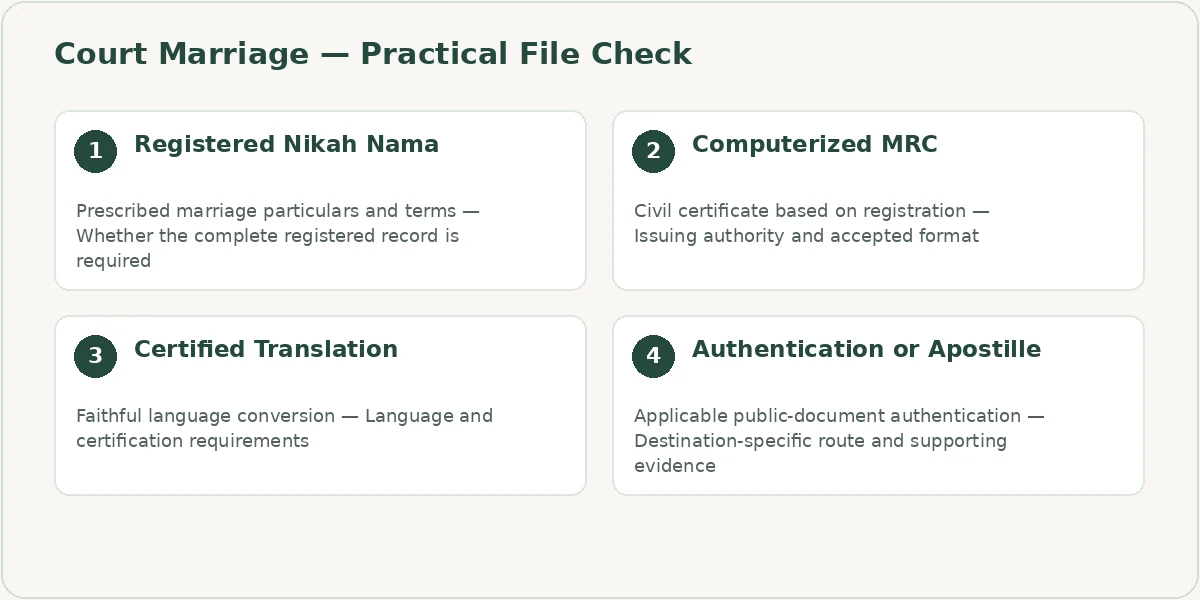
| Registered Nikah Nama | Prescribed marriage particulars and terms | Whether the complete registered record is required |
| Computerized MRC | Civil certificate based on registration | Issuing authority and accepted format |
| Certified Translation | Faithful language conversion | Language and certification requirements |
| Authentication or Apostille | Applicable public-document authentication | Destination-specific route and supporting evidence |
Court Marriage, CNIC Updates and Family Records
Updating identity-document marital information after Court Marriage is distinct from creating the local marriage entry. A Family Registration Certificate describes family composition recorded in NADRA's system. These records can support an application, but they should not automatically be described as substitutes for a registered marriage document.
If a family record appears inconsistent, identify the authority and process responsible for that record. Changing one record may not automatically correct all others. Court Marriage document planning should track which institution holds each source so that a discrepancy is addressed in the right place rather than repeated through successive applications.
Faithful Translation of the Source Record
A Court Marriage translation should follow the source document accurately, including material names, dates, amounts and conditions. It should not simplify away an inconvenient entry or change a fact to match an application form. If the source is illegible, obtain a clearer copy or appropriate clarification rather than allowing the translator to invent a reading.
The receiving authority may require a particular language, certification format or translator qualification. Check those requirements before paying for a Court Marriage translation. Court Marriage aftercare should keep the source and translation together and make their relationship clear, especially where English spellings or dates need careful comparison with a passport.
Court Marriage Authentication and Apostille Questions
For Court Marriage document use, note that the Ministry of Foreign Affairs lists Nikah Nama and Marriage Registration Certificates among attestable public documents. The applicable route depends on the document, supporting evidence, destination and intended use. An apostille, where applicable, and another legalisation procedure should not be presented as interchangeable answers for every country.
Check the current Court Marriage document process directly with the relevant authority and recipient. Authentication does not decide whether a marriage satisfies every foreign substantive rule or whether a visa should be granted. Court Marriage documentation can be genuine and properly authenticated while the receiving institution still asks for additional information or applies a separate eligibility rule.
Court Marriage and Foreign Recognition of Proxy Arrangements
Court Marriage involving a representative or remote participation requires early review of legal, religious and registration requirements. If foreign use is planned, also ask how the destination treats the particular arrangement. A video call may be practical evidence of communication, but it is not a universal guarantee of foreign recognition.
Do not rely solely on another couple's successful application in a different country or category. The facts, institution and rules may differ. Court Marriage assistance should explain the Pakistani service accurately and encourage the applicant to verify the receiving authority's requirements before committing to a route that may not suit the intended overseas purpose.
Court Marriage Documents for Overseas Applicants
If a spouse is abroad, identify who can handle Court Marriage document submission, collection or receipt and what authority is required. Do not assume that a relative may act without evidence of authority. A power of attorney, consular formalities or a different authorization may be relevant according to the assignment.
Agree on the handling of Court Marriage originals, return arrangements and delivery tracking. Use copies for initial enquiries where appropriate and send originals only when the process requires them. Court Marriage document assistance should protect a coherent record trail across countries rather than scatter originals among several intermediaries without receipts or a defined collection plan.
Resolve Discrepancies Before an Overseas Submission
Before an overseas submission, compare the Court Marriage file’s registered Nikah Nama, computerized certificate, spouse identities and translations. Check names, parentage, identity numbers and dates. Distinguish a certificate's issue date from the marriage date. An apparent difference may be explainable, but a genuine error should be corrected through the competent source rather than hidden in a translation.
Keep correction applications and replacement records where needed to explain the document history. Do not submit contradictory versions without understanding them. Court Marriage aftercare is more effective before an urgent overseas deadline, when there is still time to obtain a proper certified copy, clarification or correction.
Court Marriage Document-use Plan and Record Storage
Create a Court Marriage document-use plan listing the recipient, requested records, available documents, missing steps and responsibility for each action. Separate local registration from translation, authentication and final submission. The plan should show which authority decides each stage and what evidence confirms completion.
Court Marriage Live Service can help review that Court Marriage document route through an initial ten-minute free telephone consultation. Further searches, corrections, translations or professional work are separately scoped. Keep originals and secure backups after submission. A complete Court Marriage record is valuable for future family and administrative needs, even after the immediate overseas application has ended.
A recipient may retain a certified copy while returning the original, or may require a fresh copy for a later application. Ask about that handling before submission. Keep a list of the versions sent and the date each was issued. This makes a subsequent enquiry easier and reduces the risk of relying on an outdated or incomplete document set.
Before posting originals internationally, confirm which documents the recipient genuinely needs in original form and whether a certified copy is acceptable. List the contents of the dispatch and retain legible scans, tracking information and any return instructions. If several institutions will need the Court Marriage record, ask about certified-copy requirements early rather than sending the only original through multiple channels at once.
The aim is to preserve reliable evidence of the marriage while completing the particular application, with a clear account of which person or institution currently holds each document.
Continue Reading: NADRA Marriage Registration Service in Pakistan · Discuss Your Case
Preparing Court Marriage Documents in Pakistan for Each Recipient
Prepare a separate checklist of Court Marriage Documents in Pakistan for each receiving institution. An employer, a foreign civil register and an immigration authority may use different terminology and require different evidence. Record the precise document requested, whether an original or certified copy is needed, and any language or authentication requirement. Where the instruction is unclear, seek clarification from the recipient rather than purchasing every possible service.
Keep authoritative Court Marriage records separate from drafts and working translations. A translator should be able to identify the record being translated and reproduce its material particulars accurately. If a source is unclear, obtain a better copy or clarification. A translation should not silently choose a different date or marital-status description because a form appears to expect one. That approach can create inconsistent records across institutions.
For a spouse abroad, agree responsibility and authorization for each local Court Marriage document task. The person permitted to enquire about a record may not have authority to collect an original or request a correction. Confirm those limits with the competent authority. Keep receipts for original documents and establish how they will be returned after the particular step is complete.
When an institution questions Court Marriage documents, preserve its actual request and respond to that question. It may concern identity, the form of certification, the participation method or another substantive issue. These are not all solved by obtaining another stamp. A case-specific review can distinguish an authentication requirement from a recognition or eligibility question that only the receiving authority can decide.
Retain a Court Marriage submission history identifying the versions sent, their issue dates and whether originals were returned. If a later correction produces a replacement record, keep the proper explanation and supporting trail available. This helps avoid unknowingly using both an earlier incorrect version and a corrected version in different applications.
Accurate document use is a continuing responsibility after local registration, particularly where several countries or institutions will rely on the same marriage evidence.
If a recipient requests a newer certified Court Marriage record, clarify whether it concerns the copy’s age, missing authentication or changed particulars. These are different questions. Obtain the required record through the proper source without changing the marriage facts simply to produce a more recent-looking document.
Court Marriage FAQs
Which Court Marriage document should I obtain first?+
Identify the receiving authority's requirement. The registered Nikah Nama and computerized marriage certificate serve related but different functions and may both be needed.
Does a computerized certificate replace the Nikah Nama?+
Not for every purpose. It summarizes registration particulars, while the prescribed Nikah Nama records fuller information and agreed marriage terms.
Is an FRC sufficient proof for every recipient?+
No. An FRC concerns family composition in NADRA's records. Confirm whether the institution requires that record, a marriage certificate, the Nikah Nama or a combination.
Can translation correct an error in the original?+
No. A translation should follow the source faithfully. Genuine source errors should be addressed through the appropriate authority and supported correction process.
Is an apostille required for every country?+
No. Check the applicable authentication or legalisation route and the receiving institution's requirements for the particular destination and document.
Does authentication guarantee a visa?+
No. Authentication and immigration eligibility are different questions. A foreign authority retains its decision on recognition, evidence and visa approval.
Are proxy marriages recognized everywhere?+
Do not assume so. Destination-country and purpose-specific rules may apply, and the proposed arrangement should be checked before relying on it for foreign use.
Can someone collect documents for an overseas spouse?+
Representation depends on the competent authority's requirements. Confirm identity, authorization and any power-of-attorney formalities before appointing a representative.
What discrepancies should be checked before submission?+
Compare names, identity numbers, parentage, dates and translations across the source records. Explain legitimate differences and correct genuine errors through the proper route.
What should the final document-use file contain?+
Keep the recipient's checklist, registered records, certificates, translations, authentication evidence, receipts and relevant correspondence, with secure backups and tracked originals.
Official Legal and Registration References
These guides concern adult Muslim marriage and related documentation. Special circumstances require review under the applicable law and the competent authority's current procedure.
Edited for Court Marriage Live Service · Last Updated: